Working with House of Cosmo, we demonstrated that CGI offers agility that physical photography simply cannot match. When the concept for “New Eden” shifted from floating bottles to a grounded forest, we adapted instantly without the delays of a reshoot.
We discovered that adding “intentional imperfections”—like specific light refractions and “moon dust”—was essential to avoid a sterile “AI look” and ground the futuristic bottles in reality. By fine-tuning details like the matte metallic foils and specific glass gradients, we ensured absolute brand consistency while meeting the strict deadline for their exhibition.
Launches are brand declarations for a luxury fragrance brand. That very first visual that the customer sees defines the brand’s identity. And if not done right, their entire promise of quality falters. This was House of Cosmo’s request from us. Their motto is “Explore the future through scent.” They’re visionary and dead set on futuristic concepts, so of course, they reject traditional inspirations. Their scents ‘New Eden’ and ‘Luna Minerale’ are designed to evoke a completely new olfactory experience. But how do you express that through images?
The foundational CGI product shots House of Cosmo needed for their upcoming December convention were a classic logistical nightmare. The client wanted to showcase concepts like an Eden-like garden or a mineralic moonscape. Otherworldly, yes, but crucially, the images couldn’t be “too perfect” either. Cheap-looking renders always drive customers away. And we know this too well: realism comes from mastering imperfection. So our client needed a partner with technical mastery and serious artistic sensitivity.
However, their custom-designed bottles and unique faceted caps were still months away from being manufactured. Traditional photography was simply not an option. That’s where we came in. With CGI and our team of pros, we could skip the manufacturing process and speed up the timeline by a great deal. Achieving photorealism with CGI takes a thorough understanding of how light interacts with materials, whether creating perfume bottles or luxury candle fragrance CGI visuals.
Here’s how we created a world-class visual identity for House of Cosmo faster than a traditional photography studio ever could.
Deep dive into the collaborative CGI workflow
1. Planning and the great pivot: from floating bottles to grounded worlds

As it often goes, the first stage of our collaboration was very different from the final result. Our initial brief said “cosmic theme.” The client team saw their fragrances floating gracefully in abstract cosmic backdrops (e.g., nebular gas clouds and exploding supernovas). But it was the same team that saw our initial round of concepts and said, “Nope. Let’s do a full 360 on it.”
The new creative vision was to ground the products in tangible yet otherworldly places. That’s how we ended up making a rocky moon-like terrain for ‘Luna Mineral’ and an alien forest for ‘New Eden.’ And we’re proud of them! Pivots like these aren’t setbacks. They challenge our team to think outside the box, and they usually deliver the brand a more unique identity, too.
Those more realistic surfaces give House of Cosmo a sense of place, substance, and premium quality. Abstract cosmic voids would not have done the same. This is the genius of CGI. Now imagine trying to get this in a traditional photography studio. Yep: prohibitively expensive and time-consuming, if not impossible. Now, with a happy client, we could proceed to the technical part, a.k.a. 3D modeling.
2. Modeling: building the digital twin

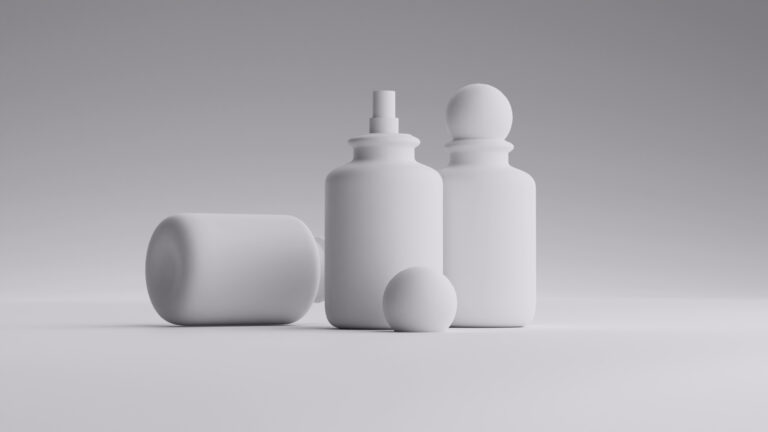
Our 3D modeling stage always begins once the artistic vision is set in stone… or, you know, until both parties agree on one. Now, our engineers could build the foundational 3D model for each House of Cosmo fragrance. That is a perfect digital twin of the custom bottle and its striking multi-faceted cap. And yes, this is technical prowess and art, because our team has to replicate every curve, edge, and proportion while also keeping a clean topology and optimized polycount for efficient render times.
And if this doesn’t sound complicated enough, there’s always a spontaneous hurdle somewhere in this process. This time, it was making sure the label area on the model precisely followed the subtle curvature of the glass bottle. Miss that, and the text and logo would warp in the most unnatural way in the final render — customers notice things like that right away, and these are precisely those kinds of mistakes that lose brand credibility. Once the team nailed this core model, it became the master asset for every scene. We had the structure. Now, we needed the surface.
3. Texturing and shading: achieving hyper-realism and the "impossible shot"

Achieving photorealism with CGI takes a thorough understanding of how light interacts with materials. It’s just like professional photography, except it’s done inside a computer. Since the client needed futuristic concepts, though, this made it a little trickier. We couldn’t just replicate real-world materials. We thus developed a custom glass shader that we thought looked alien and luxurious. The alien part meant it captured light in a way that physical glass couldn’t. But it also met their specific requirements: 80-90% opacity at the top, fading down to a more transparent 10-20% at the base.
Then came the bottle’s label. The House of Cosmo team wanted a “soft touch” matte finish with a metallic silver foil stamp. Our team knew they had to avoid generic, shiny chrome and try a matte surface that felt velvety, not flat. The good part is, CGI gives us full control over every highlight. In traditional photography, capturing shiny objects without reflection is famously hard. Well, we got that “impossible shot” right. Now, our digital materials were perfected, and the stage was set for the final (and most collaborative) phase: rendering and refinement.
4. Rendering and revisions: the art of collaborative refinement

We can’t stress the word “collaborative” enough. The final stage involved our team at Welpix, House of Cosmo, and the client stakeholders, C.M. and Kit Wilkins. This is the bit where images truly come to life: think rendering, review, and refinement, time and time again, until everyone is happy.
The evolution of the ‘New Eden’ scene is the perfect example here. C.M. asked for the trees to be a little more alien. Kit asked to make the flowers white or bluish (instead of pink) for a more unisex feel. Our artists had their own suggestions regarding textures, shades, and more. Together, we perfected a subtle aura around the bottle.
So, we went from art direction to technical rendering to digital cinematography. And that’s core to our artistic philosophy: adding those subtle, real-world imperfections to our renders. Take bokeh, soft fringing, or chromatic aberration. All of these erase the sterile, “too perfect, too CGI” look; a look that, let’s be real, plagues so much digital work today.
Project results: stunning visuals and strategic business value


Not only were we impressed by the results, but House of Cosmo was now empowered to launch their brand confidently and, most importantly, on schedule. Suffice to say, the results spoke for themselves when their launch brought new and excited customers to their website.
We need to stress out something else, too. House of Cosmo’s pre-launch marketing campaign built serious brand equity and secured convention interest before manufacturing costs. So this digital-first approach de-risked their launch big-time. The House of Cosmo team established a strong identity in 2025’s super-competitive fragrance market before they made a single product — now, they could move on to manufacturing without any stress.
Conclusion: your vision, realized with CGI
Our House of Cosmo project is just one example (but a good one, we think!) of how professional CGI workflow solves tough business challenges. CGI provides creative control and flexibility like traditional photography just can’t do. The only limit to the story your brand can tell is your imagination.

Collaborating with Welpix allowed us to bypass physical prototypes and secure hyper-realistic visuals just in time for our convention. Their team expertly translated our futuristic vision, perfectly capturing complex details like matte metallic foils and intricate glass gradients for our Crimson Aura and New Eden lines.
We were particularly impressed by their flexibility in pivoting “New Eden” from a floating concept to a grounded, alien landscape without logistical delays. The final 4K renders are stunning and perfectly suited for our large-scale exhibition booths.
The cost of Cosmo (and how we price our projects)
We already said CGI is the cheaper option than traditional photography, and we’re sure of it. Think of all the photoshoots, reshoots, travel, and actual products saved. But that’s not all. Take a look at our pricing table to see how transparent it is, and how easy it is to calculate depending on what you want. Do you want an image or an animation? Should the background be white, use simple props, or custom (with unlimited creative freedom)? Use the calculator and, why not, speak with our team today!
- 3D modeling
- White bg.
- Minimalistic
- Simple prop
- Custom
- 3D modeling
- White bg.
- Minimalistic
- Simple prop
- Custom
FAQ
How do we prepare the necessary reference images for 3D modeling?
For the House of Cosmo project, the client provided technical drawings of their custom bottle and cap. This, along with a clear creative brief and mood board images for each fragrance concept, let our team to build a dimensionally accurate and artistically aligned 3D model from the start.
What technical steps ensure a complex 3D product model is accurate?
Attention to detail is paramount here. For the House of Cosmo bottle, we focused on perfect symmetry while maintaining a clean topology and optimized polycount to ensure efficient render times without sacrificing detail. We paid extra attention to the faceted cap and the subtle curve of the body where the label would be applied.
How is hyper-realistic reflection achieved on glass or liquids?
We build complex materials that simulate how light interacts with real-world surfaces. For this project, we created a custom glass shader with a specific color gradient and opacity falloff (matching the client’s request). We then refined realism by adding subtle imperfections and controlling the environment’s reflections to nail that authentic look.
What is the difference between High-Res and Low-Res CGI outputs?
We render final images in very high resolution (4K). This is vital for large-scale use like the exhibition booth graphics House of Cosmo needed. From these master files, we can then generate web-optimized, lower-resolution versions for e-commerce and social media that load quickly without sacrificing visual quality.
How do clients typically use the CGI assets we deliver?
The assets are incredibly flexible. House of Cosmo used their images for pre-launch marketing, a major industry convention, and their e-commerce product pages. Other common uses include print ad campaigns, social media content, and as a foundation for creating stunning 3D product animations.