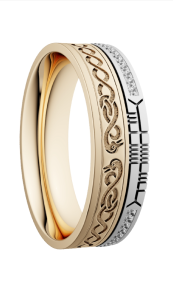
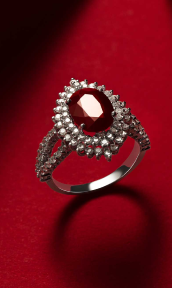
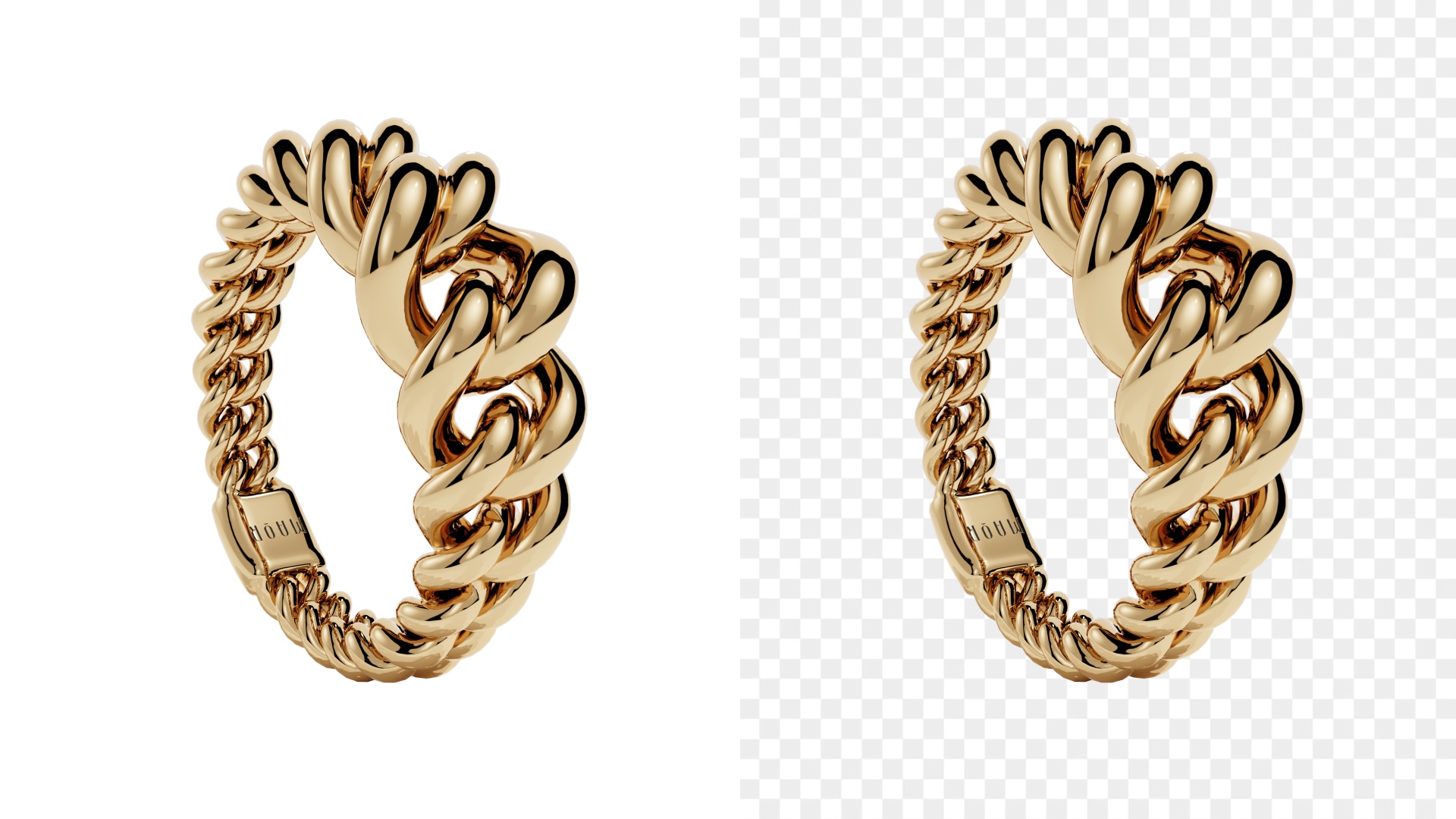
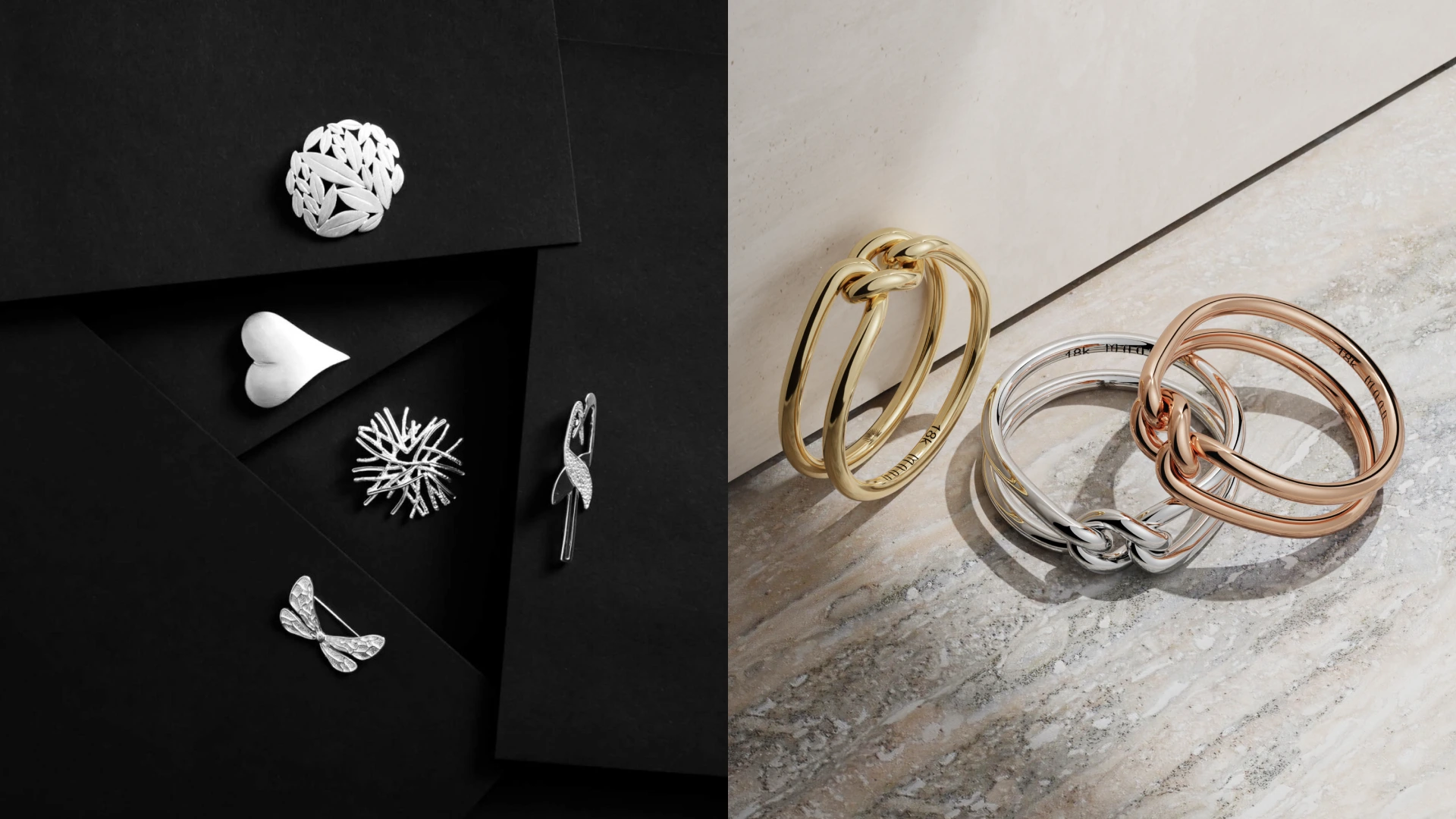
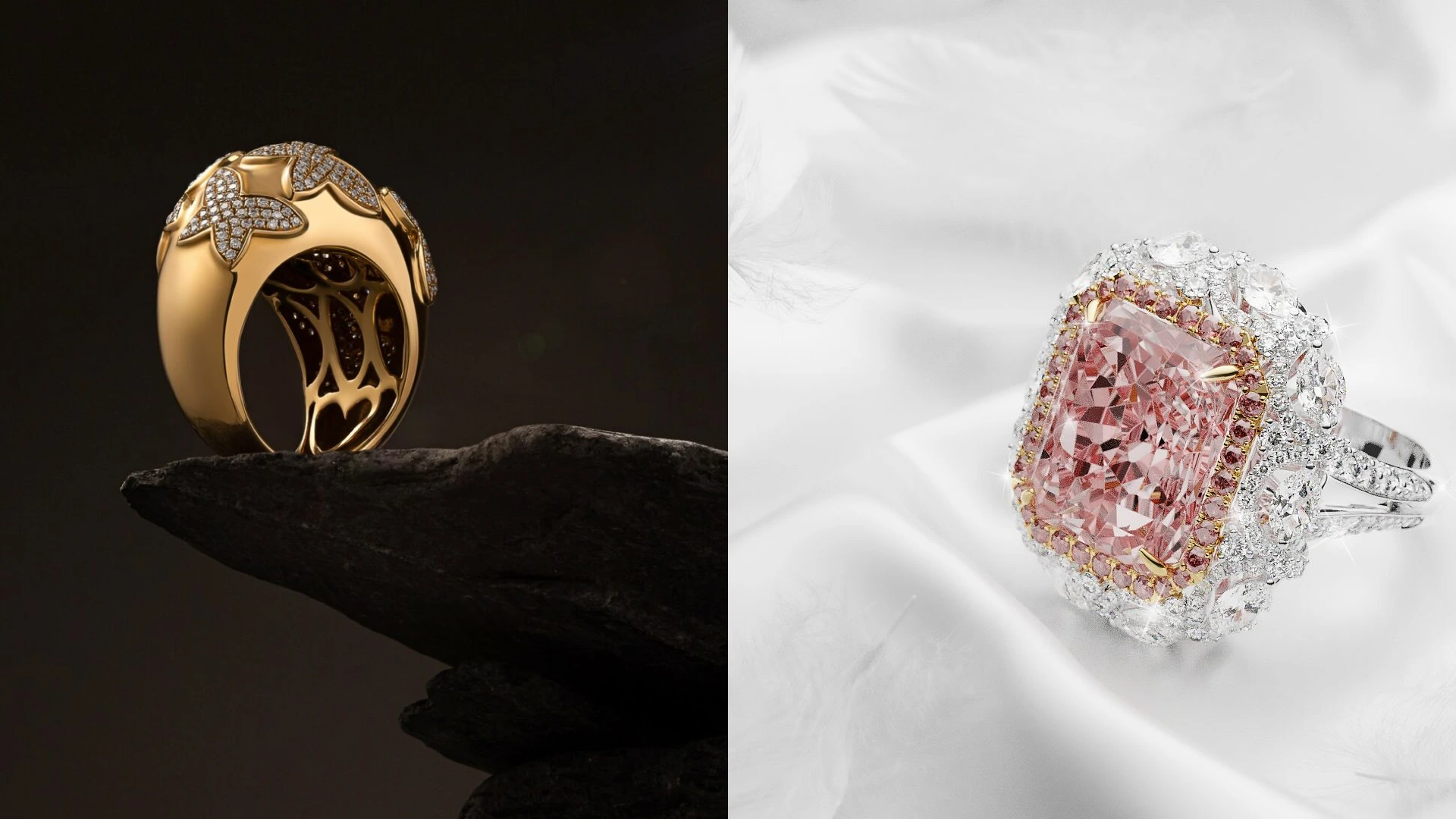
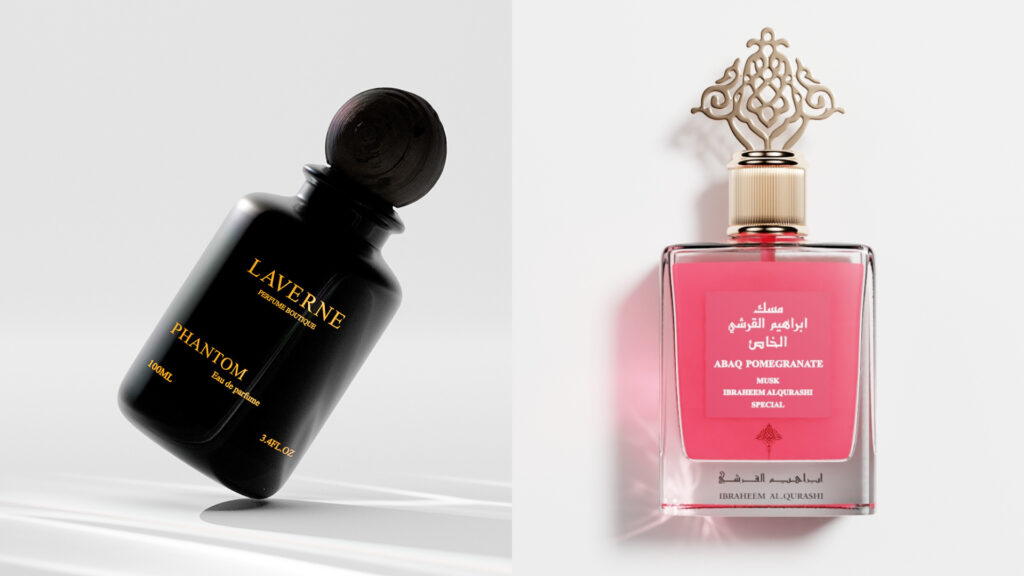
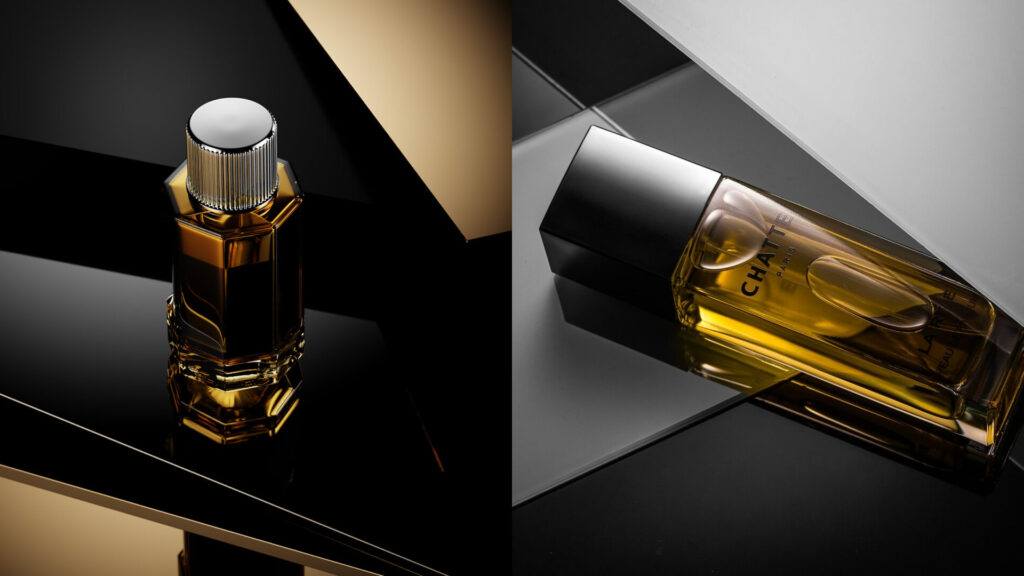
Our collaboration with Vacier was not among our easiest ones. Their founder had high standards for every detail. But that’s the type of challenge that makes us grow. By the end, we really felt we’d blurred the line between render and reality.
The revision process took over 30 hours! But that’s simply what it took to capture the authentic shine and mechanical movement of the Vacier rings. And the resilience paid off.
We delivered a gorgeous final product that nailed the client’s wishes and secured a continued partnership for their upcoming gold collection.
The bridge between a buyer and a purchase is rarely built on technical specifications. And that’s especially true with high-end jewelry pieces. The experience of that piece (perceived as it is online) is what bridges that gap.
Now, traditional photography works great when capturing static form, but it doesn’t always convey the tactile soul of luxury design. If you need to show innovative mechanics (like the glide of a mechanism or the weight of a polished surface through their screen), physical cameras really do start showing their limits.
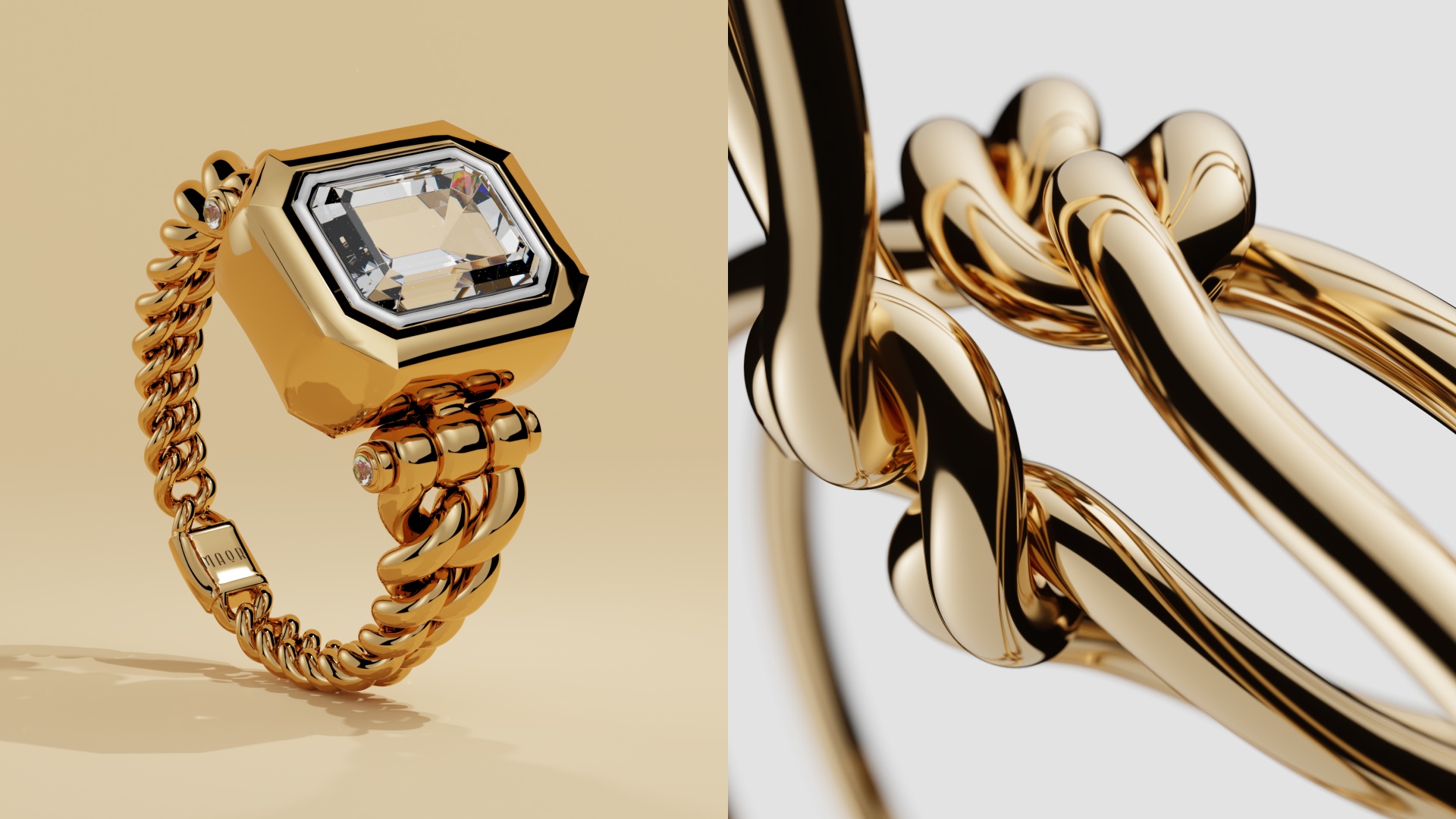
Take a look at our client Vacier’s website and you’ll see what we mean. They do impeccable jewelry with a super unique touch, and many of their pieces have unique selling points that can’t be easily communicated with one static photo. The product we worked on has a diagonal 69-degree opening that allows the ring to transition seamlessly from “open” to “overlap.” That’s notoriously difficult to film without looking choppy or losing that perfectly shiny silver luster.
What’s more, their creative vision demanded an impossible set, a.k.a. the jewelry emerging from dark, rippling liquid. That’s why CGI proved the all-around smarter choice. We delivered their polished steel look, kept the product as a hero even with a crazy background, and got Vacier the conversions they deserved. Read on to learn how we did all that.
Deep dive: Step-by-step CGI workflow and technical expertise breakdown
1. Role of CGI in luxury branding. Planning and the creative brief

CGI got Vacier perfect digital twins of their actual products. Now, these assets do more than just show this product (be it in an impossible set). They elevate consumer perception by presenting an idealized, yet believable, reality. We mirrored the physical craftsmanship of the jewelry and highlighted the polished steel without the distracting blemishes an actual physical sample would have had.
To see how we apply this level of precision to other precious metals, visit our CGI jewelry services page.
Vacier’s art director gave us a simple mission: creating a series of eye-catching animations demonstrating the ring’s unique adjustability. Oh, and they all had to be under 10 seconds. Yep, that’s really short. But it’s also the format that converts today, so we knew exactly what to focus on.
Our projects always begin with a creative brief, where our clients add reference images and any guidelines needed before we start the modeling. In this case, we got Pinterest and Vimeo images, with Vacier pointing toward dynamic Crocs-style movement and dramatic liquid reveals.
Our architecture thus focused on creating two digital environments:
The “Water/Liquid” Scene: A high-concept reveal where the ring emerges from a dark, reflective fluid.
The “Shadow/Grey Gradient” Scene: A minimalistic, studio-style environment designed to match Vacier’s existing product catalog aesthetic.
Modeling: The 69-degree challenge
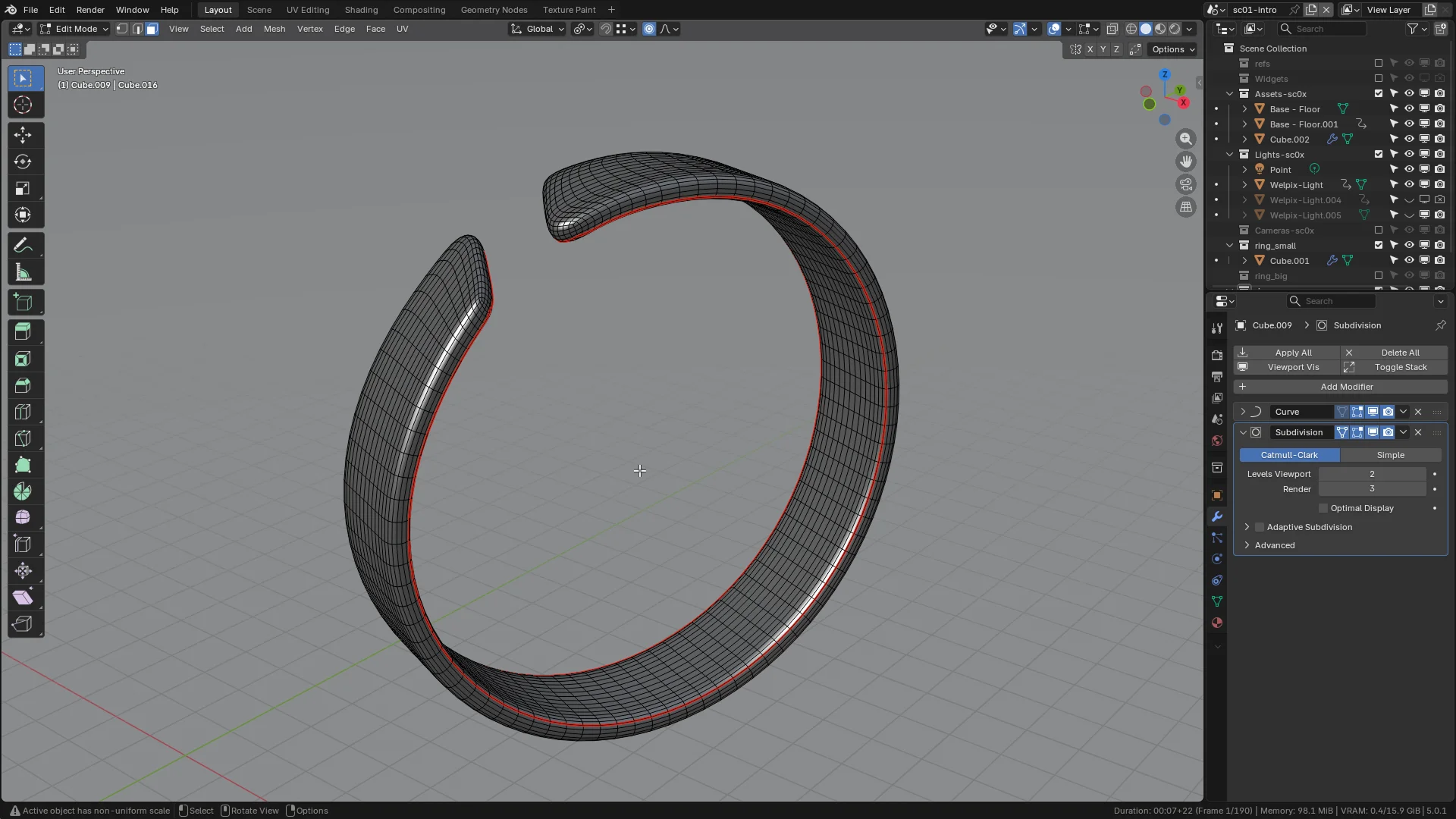
The core of this project was the component 3D product modeling. Now, without a perfect model, you don’t have perfect CGI assets at the end of it all. So the process is never without hurdles. In this project, the main challenge was the ring’s diagonal 69-degree opening. We had to balance two conflicting requirements: Vacier’s need for sharp edges to signify high-quality realism, and the fact that edges must be rounded for wearer comfort.
And that’s exactly why we keep our clients in the loop every step of the way. It was only after explaining this to our Vacier art director that we nailed that perfect balance between the two needs.
Then, there was the “overlap” mechanic. We engineered the 3D model as thoroughly as we could, to make sure there was no gap between the layers during adjustment. The top side had to sit perfectly over the bottom side to reflect the true physical design. We also solved a common CGI lag issue where the ring’s opening state appeared to “jump” during the transition from a wide shot to a macro-zoom.
We synced the overlap state across different camera rigs in our SRS scene setup, and that’s how we got a seamless, fluid motion (which, by the way, traditional filming just couldn’t replicate)
Texturing and shading the "impossible" polished steel
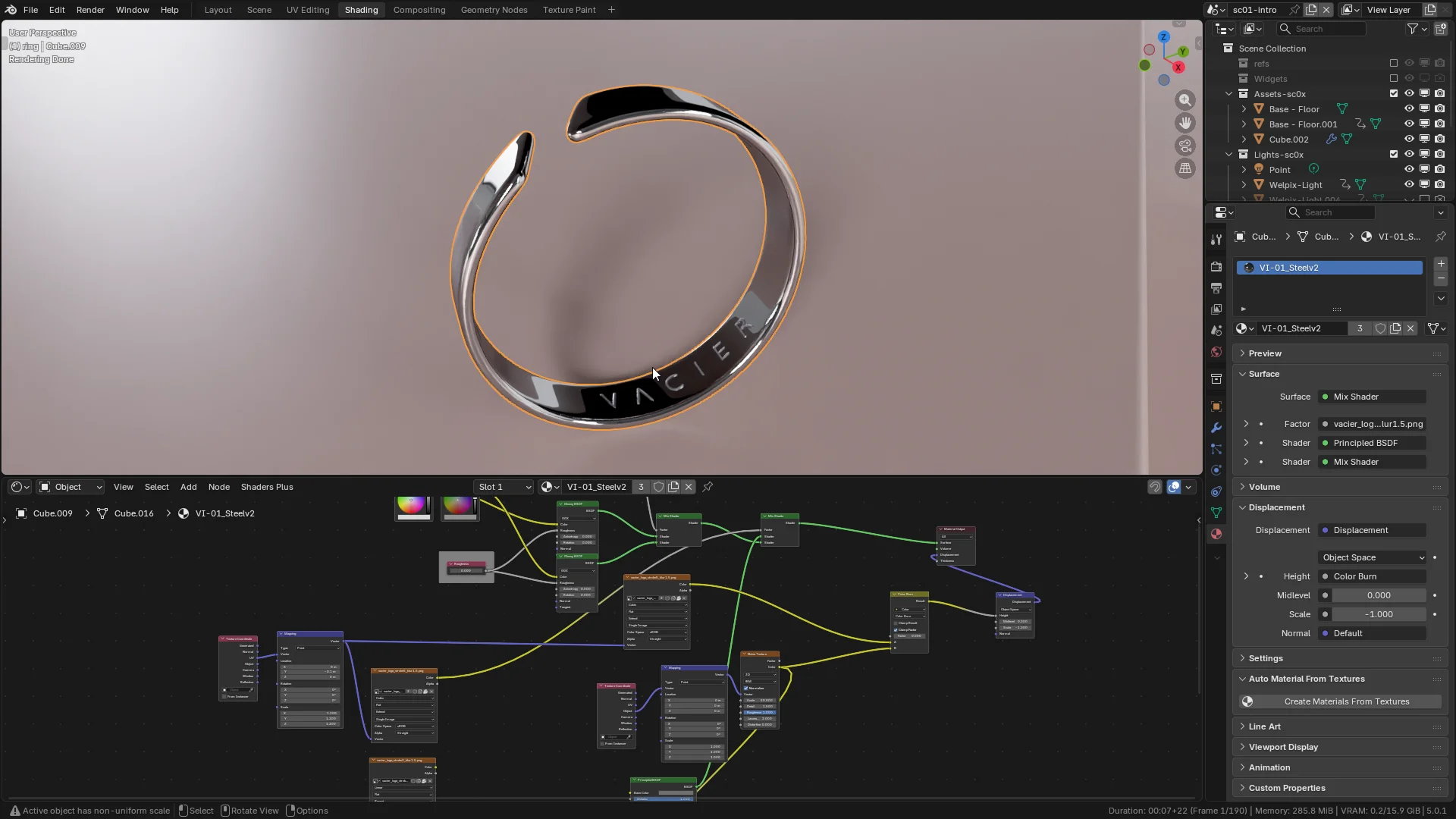
Polished stainless steel is one of those things we call the “Impossible Shot,” because it behaves exactly like a mirror. This can lead to a common error in jewelry CGI: that dull grey/black look when the environment isn’t properly mapped. Thankfully, we knew a polished surface actually looks less polished the closer you get, so we did some custom shading adjustments for macro views.
And to get that shiny silver luster (rather than a flat digital grey), we implemented custom environment mapping and high-contrast reflections. Then, for the logo etching, we moved away from flat overlays to create a more realistic texture. In this case, that was a slightly corroded, etched feel. Sometimes, CGI is all about acknowledging the minor imperfections and bringing them forward without losing the premium feel of the product.
Product lighting—The digital studio experience

Our artists always build a lighting architecture based on real-world studio physics (we have experience in that, too; you don’t get professional CGI otherwise). In the Water Scene, the challenge was creating a liquid that felt alive, as directed by Vacier. We did that by using contrasting light without distracting from the ring itself.
Then we got our first round of feedback. This led to adding diagonal strings of light that crossed the water’s surface. This was to make the symmetry of the ring stand out, but also to make the product reflect the ripples of the water without losing its own polished identity. We removed distracting box shadows and focused on gradient-softbox simulations. That way, we made sure the ring remained the brightest, most eye-catching element in the frame.
Project results: Final assets, client value, and commercial success
For fear of sounding like a broken record (in case you’ve read our previous case studies, too), we always deliver two kinds of results. First, the deliverables:
- The Water Video, showing the ring emerging from dark liquid, with lively ripples and sharp silver luster.
- The Shadow Video, a more functional animation showing the “open to overlap” adjustment, presented in a clean, high-contrast gradient environment.
Then, there’s the long-term value we delivered to our client:
- Faster Time-to-Market: Digital sets removed the need for physical liquid simulation resets and studio bookings.
- Cost Savings: Vacier skipped the need for physical product samples and the logistical costs (and, let’s face it, headaches) of liquid-simulated sets.
- Functionality Demonstration: The clear, lag-free “adjustable” mechanic builds immediate buyer trust by showing exactly how the product operates.
Take a look at our explainer video to see what we’re talking about.
Another quick proof: we established a long-term strategic partnership with Vacier. Right after this project, Vacier started a second one for their Gold Jewelry line. To see how we handle similar complex metal textures, check our [related jewelry case studies].
Conclusion (and next steps for your CGI project)
At Welpix, we see ourselves as a strategic partner rather than a service provider. Vacier chose us for the same reason so many brands before them did: our complex, ongoing feedback. Like the 30+ hour intensive revision loop needed to reach 100% photorealism for their polished steel textures.
We can’t stress enough the impact CGI has on consumer perception. When a customer sees something like Vacier’s adjustable mechanic in high definition, they’re just more likely to add to cart. We tell brands’ philosophies exactly as they want us to, and communicate that premium layer that makes people trust them right away.

I admit I’m not the easiest client to work with. I demand perfection in every detail, be it specific camera movements or the realistic shine of polished steel. Not only did the team take on this challenge, but they spent over 30 hours on revisions.
They weren’t happy until I was happy. The final result is incredible; you truly cannot separate the 3D animation from reality. I’m thrilled with the outcome, and I’ve already partnered with them again for our upcoming launch.
The cost: A transparent look at CGI project investment
Our pricing philosophy is value-based. Meaning we focus on complexity and technical requirements rather than flat rates. That way, each client gets a bespoke solution tailored to their brand’s standards.
CGI project pricing factors
| Technical Variable | Impact on Investment |
| Number of Revisions | Intensive feedback loops (e.g., 30+ hours) to perfect luster and “silver” feel. |
| Environment Complexity | High-fidelity liquid simulations and “alive” water effects require significant compute power. |
| Output Resolution | 4K rendering for maximum detail on macro-jewelry shots. |
| Modeling Detail | Mechanical complexities like the 69-degree diagonal overlap and synchronizing “no-gap” transitions. |
To learn more about how we estimate project needs and how you can maximize your visual budget, check our instructional pricing video. Translating luxury craftsmanship into pixels: A CGI workflow case study for Vacier jewelry.
- 3D modeling
- White bg.
- Minimalistic
- Simple prop
- Custom
- 3D modeling
- White bg.
- Minimalistic
- Simple prop
- Custom