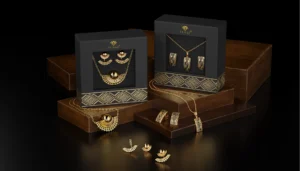
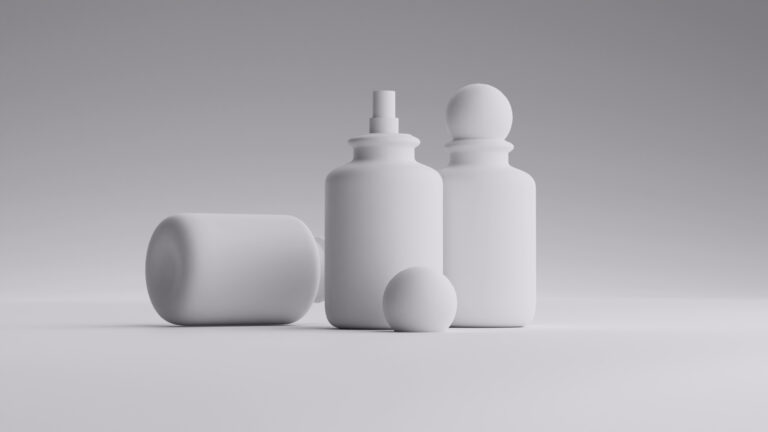
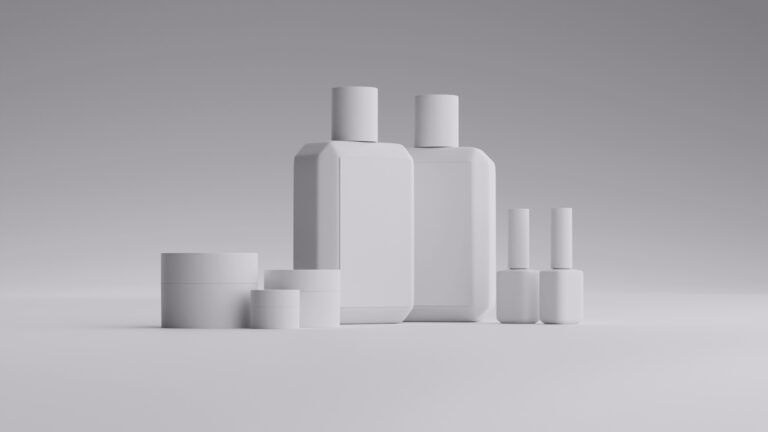
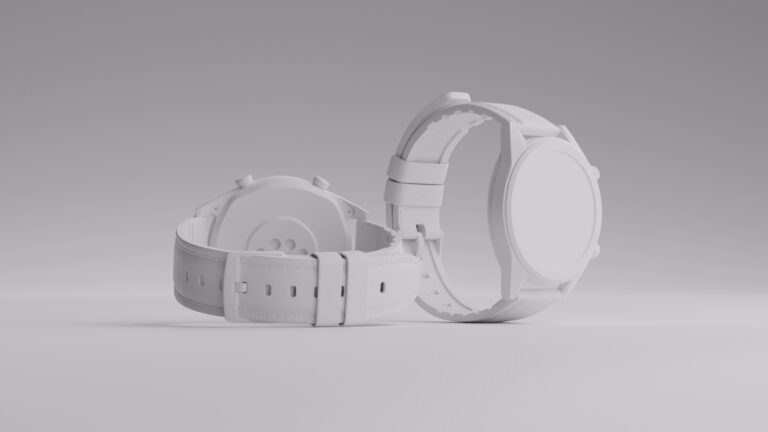
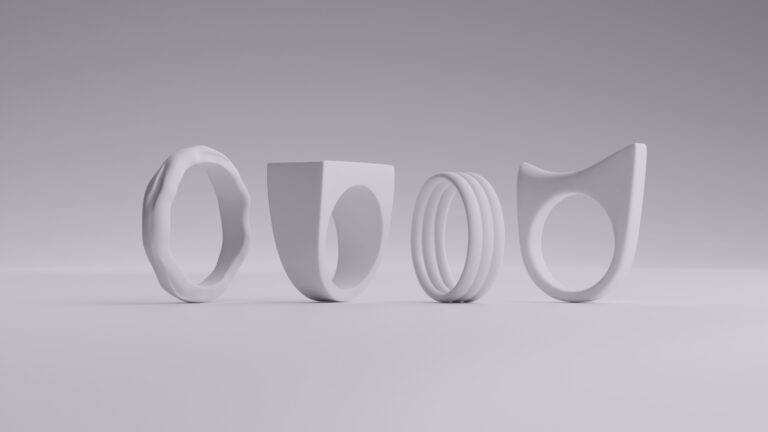
We used CGI to do Abbott Lyon’s premium jewelry pieces (from custom name necklaces to detailed watches) justice. And we did that before most physical samples even existed.
Abbott Lyon got unmatched flexibility by choosing us. They could customize their images on the go and launch their products within days, without all those pesky manufacturing delays. In fact, this project was a lesson in agility.
Priorities shifted between complex 3D modeling tasks and immediate commercial deadlines, and we had a lot of customizable products to do. And yet, we delivered clean imagery that screamed luxury. That’s the magic of CGI.
Abbott Lyon’s website speaks for itself. Their pieces are personal, meaningful, and timeless. They’re also premium quality, but online customers can’t touch or try them on. So product images are their cornerstone, and a direct driver of sales. Here’s a case study about our project AB-03, which saved Abbott Lyon’s fast-approaching launch, but not without a few hurdles
At the core of it, Abbott Lyon is about letting customers tell their own story with quality jewelry. We had to showcase exactly that. But we were approached with a tough challenge: making a large and diverse batch of consistent, hyper-realistic packshot and bundle imagery for a multi-collection launch. What’s more, some products needed a 3D model, while others already had one.
The project’s scale, tight schedule, and complex requirements (personalization and intricate materials) made traditional photography impossible. Computer-Generated Imagery (CGI) was the only path forward: they knew it, we knew it, and we offered a solution that nailed their vision.
Deep dive: A step-by-step CGI workflow for luxury jewelry
Planning and scope definition from the creative brief
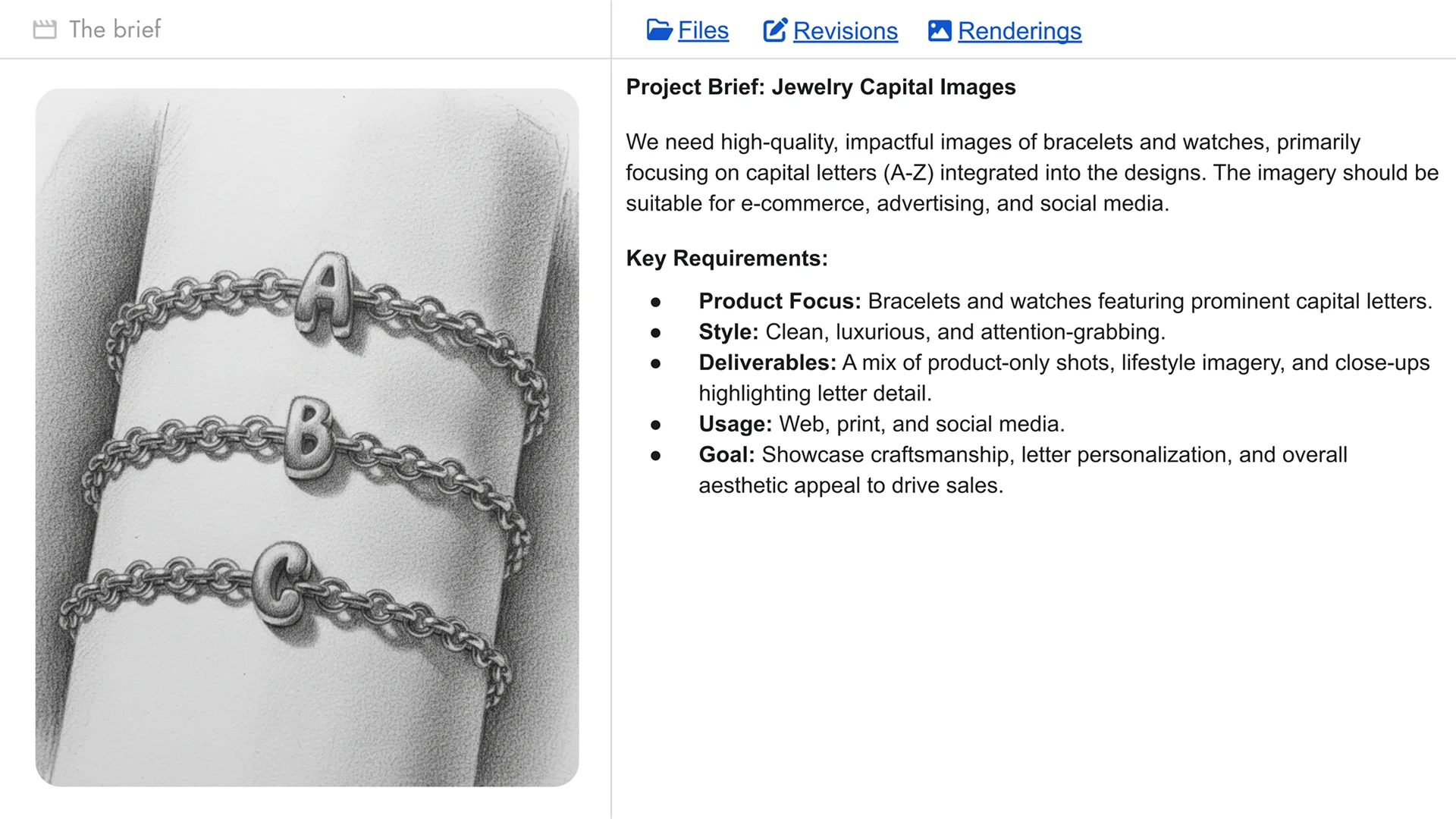
The project began with a super thorough planning phase. The starting point was Abbott Lyon’s creative brief — that’s where they told us which pieces needed what, and their overall creative vision.
Our first step was a critical asset audit to de-risk the project. Sounds fancy, we know, but it’s not. It means we identified which products required 3D modeling from scratch and which already had 3D files, needing micro edits. That’s how we established a clear roadmap for resource allocation, and that’s also how we provided a realistic production timeline from day one. Now, Abbott Lyon could also figure out their own steps around this deadline.
Their initial request: “a batch of packshot imagery” to support a new launch, sprinkled with “bundle images” for some of the products. These would feature several jewelry pieces in one elegant shot. Think a bunch of stunning bracelets arranged on a tube display, arranged by color or detail. The creative direction combined “Minimalistic” and “Simple props.”
High-fidelity 3D product modeling

The 3D modeling phase was, as it usually is, the most demanding part of the project. First of all, we needed to estimate an accurate and realistic deadline for the Abbott Lyon team. We used our experience with our prior project, AB-02. And we got it right: between 300-350 hours for modeling. Yep, it really takes a lot of effort. That’s why we assigned a team of three artists to make sure we met the deadline without compromising on detail or quality in any way. Their goal was to make perfect digital twins of each piece. However, that’s easier said than done, as many tiny challenges appear before that’s done.
The personalized necklaces were our first modeling challenge. For the Multi Signature Name Necklace, we had to turn a 2D cursive font file into a three-dimensional model with proper topology. Simply put, we had to make sure the delicate script kept its calligraphic elegance and volumetric feel. It can easily become flat or distorted if not done right.
The Multi Crystal Cursive Name Necklace was even tougher. Our team had to painstakingly set hundreds of tiny, individual crystals onto the surface for a flawless pavé effect. The accuracy of this stage was hugely dependent on those high-quality reference materials we got from the Abbott Lyon team: images and videos showing their pieces 360. Perhaps stating the obvious, there can’t be any perfect digital twin without a perfect understanding of the physical product.
There was a pickle here. The reference images for the necklaces proved incomplete. That meant 20 more hours of work — something we call “design adaptation phase,” but something that can prove fatal to a successful launch if it pushes the new timeline too far back. It rarely does, though. This flexibility is a core advantage of a CGI workflow.
Think about it: discovering incomplete references late in a traditional photography process would have required a reshoot, which would have cost much, much more, in time and money. With CGI, we can pivot efficiently and make sure the final digital product is an exact match to the physical one.
Now, we had the pieces’ geometric forms nailed to perfection. Our next challenge was to bring them to life with realistic surfaces and materials.
Advanced texturing and realistic shading

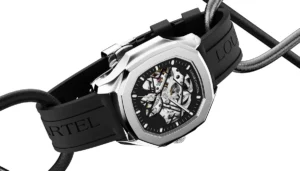
This is the fun part! Here, our artists focused on creating the hyper-realistic materials (or shaders) that made the models indistinguishable from actual pictures. The Aqua Moon and Back Belgravia Watch is a perfect example. Our team developed a suite of complex, multi-layered shaders to reproduce those distinct qualities of lustrous, polished gold, the cool reflections of brushed silver, the iridescent depth of an aqua mother-of-pearl face, and the precise, fiery sparkle of diamond hour markers.
The Solitaire Pear Ring, on the other hand, wasn’t as easy. Here, the focus was on perfecting a single, highly complex material: the diamond. Getting that convincing look took advanced shading techniques, as light interacts in super-specific ways with diamonds. It refracts one way within the gemstone and reflects off its facets. This is what we call the “Impossible Shot,” with a touch of humor, as CGI always gets it right. In this controlled studio environment, we can produce flawless reflections on highly polished metallic surfaces and remove unwanted reflections, fingerprints, and dust. Needless to say, this is a true headache to realize in a traditional photography studio.
After the materials and lighting were done and made the Abbott Lyon team happy, the scenes were ready for the final rendering and post-processing steps.
Final rendering and post-processing

This is the fun part! Here, our artists focused on creating the hyper-realistic materials (or shaders) that made the models indistinguishable from actual pictures. The Aqua Moon and Back Belgravia Watch is a perfect example. Our team developed a suite of complex, multi-layered shaders to reproduce those distinct qualities of lustrous, polished gold, the cool reflections of brushed silver, the iridescent depth of an aqua mother-of-pearl face, and the precise, fiery sparkle of diamond hour markers.
The Solitaire Pear Ring, on the other hand, wasn’t as easy. Here, the focus was on perfecting a single, highly complex material: the diamond. Getting that convincing look took advanced shading techniques, as light interacts in super-specific ways with diamonds. It refracts one way within the gemstone and reflects off its facets. This is what we call the “Impossible Shot,” with a touch of humor, as CGI always gets it right. In this controlled studio environment, we can produce flawless reflections on highly polished metallic surfaces and remove unwanted reflections, fingerprints, and dust. Needless to say, this is a true headache to realize in a traditional photography studio.
After the materials and lighting were done and made the Abbott Lyon team happy, the scenes were ready for the final rendering and post-processing steps.
Project results: Final images delivered to client


We ended up delivering a large and smartly diverse collection of e-commerce assets. Not only did they meet Abbott Lyon’s premium standards, but they told their story and nailed their vision. That’s brand credibility if you can sum it up in two words. And we may sound like a broken record, but with CGI, this was done faster and cheaper than any traditional photography studio could offer.
The final deliverables included:
- Individual, high-resolution packshots for a wide range of product types, including the Amazonite Ring, Pale Pink Opal Heart Huggie Earrings, necklaces, and watches.
- Complex “bundle” compositions, such as the Mini Pearl Bracelet Bundle, showing several products in a single, styled image.
- Multiple material variations, including both gold and silver versions of assets like the Pearl & Initial Bracelet Bundle and Multi Signature Name Necklaces.
- Diverse gemstone materials, including Light Blue Lace Agate and Green Quartz for earring bundles and the MULTI STONE QUARTZ BRACELET.
- Personalized assets, showing the customizable name necklaces in some of the most asked-for names: ‘Emily’, ‘Sophie’, ‘Lily’, ‘James’, ‘Isla’, ‘Oliver’, ‘Arlo’, and ‘Grace’.
- Engraved products, highlighted by the MOON AND BACK RING featuring a clear “To the moon and back” inscription on the inner band.
Beyond these final (and gorgeous) images, CGI delivered massive strategic value. Our workflow eliminated the prohibitive costs and logistical headaches of multiple international photoshoots (yep, this international angle often makes traditional photography even tougher and way more expensive). Our assets let Abbott Lyon launch multiple collections on an aggressive timeline, and it solidified their brand identity for future collabs too.
This is what a specialized CGI workflow can bring to the table.
Conclusion: The strategic advantage of a specialized CGI workflow
The success of Abbott Lyon’s project shows professional CGI for what it is: a smart asset for e-commerce brands today. We’re in a market that demands unprecedented speed, flexibility, and uncompromising quality. With so many options online, customers won’t settle for any less now.
CGI provides a scalable solution that traditional photography just can’t match right now. We can model perfect-looking products from reference images, create endless variations on demand (think how cool this is when you want to do a quick Christmas edition for an already existing product), and solve logistical hurdles like unavailable samples.
Our expertise in 3D product modeling and hyper-realistic 3D product rendering lets brands overcome any traditional production limits. In fact, your only limit is your imagination! Take a peek at our core CGI services to see how we can help.
The cost: How Abbott Lyon saved thousands of dollars with us
We can’t stress enough that CGI is cheaper than traditional photography. And our Abbott Lyonn case study is the perfect example. They didn’t have all the products ready, and they were operating across several countries, which meant carbon footprint and shipping costs on top.
Pair that with the mid-project deadline change, and all those traditional shoots and reshoots would have cost them more than the launch was worth. With CGI, they avoided all that. Take a look at our pricing table to see how transparent it is, and how easy it is to calculate depending on what you want.
Do you want an image or an animation? Should the background be white, use simple props, or custom (with unlimited creative freedom)? Use the calculator and, why not, speak with our team today!
- 3D modeling
- White bg.
- Minimalistic
- Simple prop
- Custom
- 3D modeling
- White bg.
- Minimalistic
- Simple prop
- Custom
FAQ
How do you start 3D modeling without a physical product?
All we need are high-quality reference materials. A short video of the product and clear photos from all angles, along with key measurements and a creative brief, give our 3D artists all the necessary information to build an accurate and detailed digital model.
What ensures a complex 3D jewelry model is accurate?
Our process focuses on precision topology and perfect symmetry, especially for intricate items like chains or cursive nameplates. We manage polygon counts for efficiency while ensuring every detail, from clasps to stone settings, is a perfect twin of the actual piece.
How is hyper-realistic reflection achieved on metals and gems?
We use advanced shading techniques and digitally constructed lighting environments that mimic professional photo studios. This lets us control light interaction precisely, and make flawless reflections and refractions that often surpass what’s possible in photography.
What’s the difference between high-res and low-res CGI outputs?
We deliver assets tailored to their final use. High-resolution (hi-res) files are rendered for large-format print or marketing materials. Low-resolution files are optimized with smaller file sizes for fast loading times on e-commerce sites and web banners.
How does CGI handle product variations like gold and silver?
Once a 3D model is approved, creating variations is easy and highly efficient. We can easily apply different material shaders (like gold, silver, or rose gold) and re-render the product, ensuring perfect consistency across all versions without needing a new photoshoot.